Outdoor Spots
Seasonal Guide: Where to See Bluebells in the UK in May
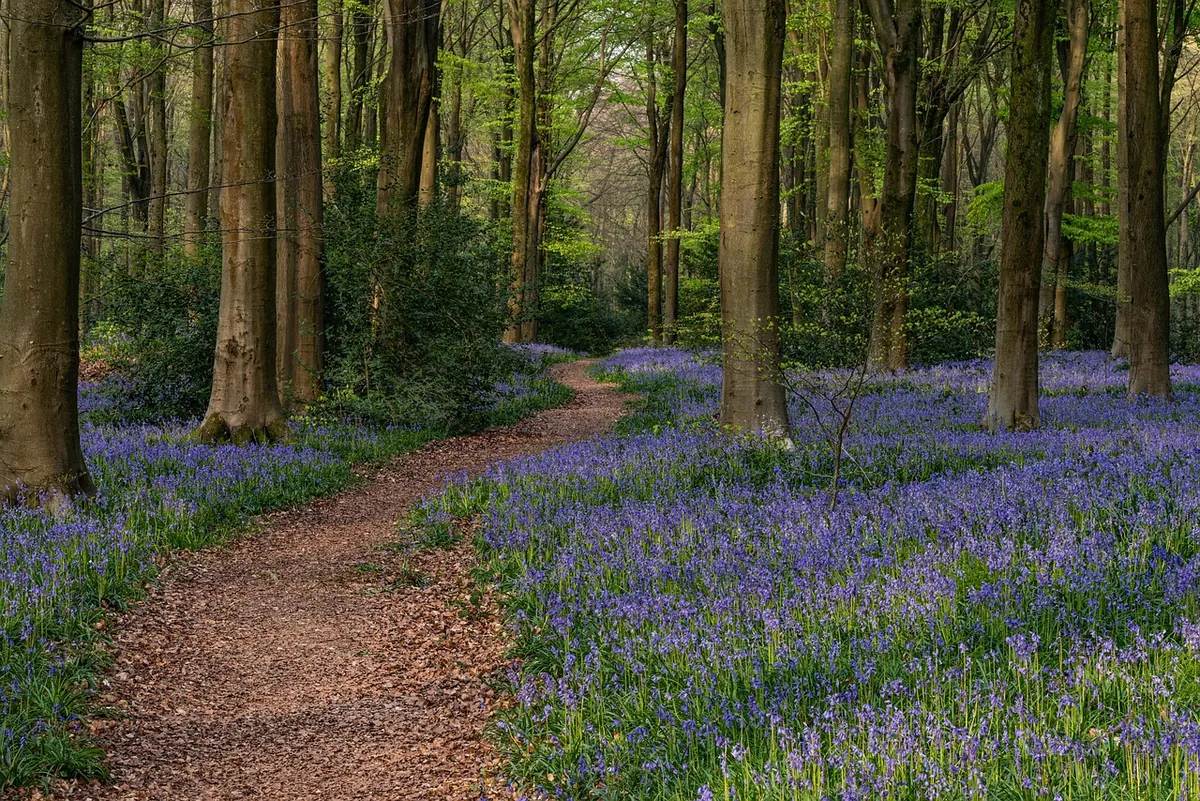
For three or four weeks each spring, parts of Britain turn a colour that is hard to describe and impossible to forget: a soft, smoky violet-blue that sits low under the trees and vanishes the moment the canopy closes. Bluebells are slow to spread and slow to recover, which is exactly why a good wood feels like a small piece of luck. Time it right and a half-hour walk becomes the best thing you do all month.
Here is what to look for in a wood, how the season moves through May, and how to enjoy it without damaging colonies that take decades to build.
What makes a good bluebell wood
Bluebells (Hyacinthoides non-scripta) are woodland plants above all. They flower in the narrow window between the soil warming up and the trees closing over, so the finest displays come from woods where that window is widest and the ground has been left alone for a long time.
A few things give a wood away before you even see the flowers:
- Age. A dense carpet usually points to ancient woodland — land that has been continuously wooded for centuries. Bluebells spread very slowly, so a thick display suggests a wood that has never been ploughed or cleared.
- Spring light. Coppiced woods, where sections are cut on a rotation, let in the dappled light bluebells like. So do mature beech woods on chalk and limestone, where the flowers open before the leaves thicken.
- Soil and drainage. Damp but free-draining ground suits them best. They dislike waterlogged clay and the deep needle litter of conifer plantations.
- Aspect. South-facing slopes warm up first; north-facing slopes hold their colour a week or two longer.
If you are choosing between two local woods, pick the older-looking one: broadleaved trees of uneven ages, a hedge bank or two, moss on the trunks. Bluebells are one of the best indicators of a wood with real history behind it.
How the season moves through May
Bluebell season runs roughly from early April to early June, but where you are matters more than the calendar. In a mild spring, the first deep colour appears in Cornwall, Devon and along the south coast before the end of April. By the first fortnight of May, the Chilterns, Kent, Sussex, the Midlands and East Anglia are usually at their best. Northern England and Scotland follow on, with woods in Cumbria, Yorkshire and Perthshire often holding colour well into the second half of May.
Altitude and shelter shift things again. A valley wood several hundred metres up can lag a lowland wood twenty minutes down the road by a fortnight, which is handy if you have missed the peak near home — head north, or uphill, and you buy yourself time.
Weather decides the rest. A warm, dry spell brings the season forward; a cold snap holds it back. Strong wind, hail or a late frost can flatten a display overnight, so it is worth checking recent photographs before a long drive. National Trust and Wildlife Trust properties often post bluebell updates on their pages, and local nature groups are frequently quicker than any official listing.
The hour of day matters too. Early morning and late afternoon give the low, soft light that makes blue look blue; midday sun flattens it to a hazy mauve. Overcast days are quietly excellent — rich colour, no blown highlights, no squinting. And go on a weekday if you can. The famous woods can feel like a car park on a sunny Saturday in May.
Bluebell woods worth the journey
Displays rise and fall with weather, coppicing and grazing, so treat this as a starting list and check the site's own updates first.
- Ashridge Estate, Hertfordshire — beech woods on the Chilterns escarpment, with big carpets and miles of walking to spread people out.
- Emmetts Garden, Kent — bluebell woodland on the North Downs; pair it with a longer ridge walk for a full day out.
- Blackbury Camp, Devon — an Iron Age hillfort ringed by beech and bluebells. Small, atmospheric and quiet early in the morning.
- Clumber Park, Nottinghamshire — oak and birch woodland with a long season and plenty of space when it is busy.
- Hardcastle Crags, West Yorkshire — a steep, wooded valley above Hebden Bridge, reliably later than the south.
- Kinclaven Bluebell Wood, Perthshire — a Woodland Trust site and one of the most northerly bluebell woods in Britain, usually at its best in late May. A good bet if you have missed the peak further south.
Native bluebells and Spanish invaders
Not every bluebell you see is a true native. The Spanish bluebell (Hyacinthoides hispanica) is a popular garden plant that has escaped into the wild and now hybridises with our native species. The differences are worth knowing, partly because native colonies are the ones we want to protect.
Look closely at a flower spike. Native bluebells have narrow leaves, deep violet-blue petals, and a drooping stem with most flowers hanging to one side. The pollen inside is cream-coloured, and the scent is sweet and strong. Spanish bluebells are more upright, with paler blue — sometimes pink or white — flowers arranged all around the stem. Their pollen is blue, and they have little or no scent. Hybrids sit somewhere in between, which can make identification tricky.
If you garden near an ancient wood, avoid planting Spanish bluebells. They spread readily and can overwhelm native colonies, diluting the gene pool that took centuries to establish. Stick to native bulbs from reputable suppliers, or better still, enjoy the wild ones where they belong.
Bluebell etiquette: enjoy them without leaving a mark
Bluebells take years to establish and are surprisingly easy to damage. A single footstep can crush the leaves that feed the bulb, and trampled plants may not flower again for several seasons. With that in mind, a few simple rules will help keep a wood healthy for the next visitor.
- Stay on the path. Wander into a drift for a photo and you may be standing on dozens of bulbs. Use a telephoto lens or kneel at the edge instead.
- Never pick or dig up. It is illegal to dig up wild bluebell bulbs, and picking flowers prevents them from setting seed. Leave every bloom where it is.
- Keep dogs and children close. A dog crashing through the undergrowth can flatten a patch in seconds. In sensitive woods, keep dogs on a short lead.
- Don't transplant wild bulbs. They rarely survive the move, and you are taking from a habitat that needs every plant.
- Take only photographs. The best souvenir is a picture, not a posy that will wilt before you get home.
Bluebells are slow to spread and quick to damage. Enjoy them where they grow, and leave them exactly as you found them.
If you miss the peak
Don't worry if the woods near you have already gone over. The season is a moving wave, and you can often catch it again by heading north or uphill. North-facing slopes and higher ground hold their colour later, and some Scottish woods do not peak until early June. Check local Wildlife Trust pages for late-flowering sites.
Even after the bluebells fade, May is a generous month in the woods. Look for wood anemones, wild garlic carpeting damp hollows, early purple orchids, and the first unfurling of fern fronds. The blue may be the headline act, but the supporting cast is worth the ticket too.
Photo: ebor / Pixabay
Related Articles